From Overflow to Pump Failure: Why Buildings Need Smart Water Monitoring

Table of Contents
- From Overflow to Pump Failure: Why Buildings Need Smart Water Monitoring
- The Operational Gap in Traditional Water Management
- Overflow and Dry Run Create Bigger Facility Risks
- Smart Monitoring for Tanks, Sumps, Pumps, and Borewells
- Water Monitoring as Part of Smart Building Management
- thingZmate® for Centralized Water Visibility
- Case Study Connection for Connected Water Infrastructure
- Smarter Water Visibility for Reliable Building Operations
From Overflow to Pump Failure: Why Buildings Need Smart Water Monitoring
Water is a daily operational requirement in every building, but it is often managed with limited visibility. In apartments, campuses, hospitals, hotels, commercial spaces, and industrial facilities, water systems depend on tanks, sumps, pumps, borewells, and distribution lines working without interruption. When these systems are monitored manually, teams may notice problems only after overflow, dry run, shortage, or pump failure has already affected operations. Smart water monitoring gives buildings real-time visibility and helps facility teams act before small issues become costly failures.
The Operational Gap in Traditional Water Management
Traditional water management depends on manual tank checks, physical pump inspections, and delayed communication between facility teams. This creates visibility gaps during peak usage, non-working hours, and multi-block operations.
- Tank levels are checked manually.
- Pump operation needs physical inspection.
- Borewell status is often unclear.
- Overflow and dry-run risks are detected late.
- Facility teams lack one clear dashboard.
- Water usage is not tracked properly.
Overflow and Dry Run Create Bigger Facility Risks
Tank overflow is not just water wastage. It increases pump runtime, raises utility cost, affects service areas, and weakens sustainable building operations. Dry-run conditions create another major risk because pumps may run without enough water and face overheating, motor stress, or failure. With real-time tank level monitoring and pump status visibility, facility teams can identify abnormal conditions early and reduce unnecessary maintenance pressure.
Smart Monitoring for Tanks, Sumps, Pumps, and Borewells
A smart building water monitoring system connects key water assets and converts field-level conditions into useful operational data. It helps teams monitor water availability, pump activity, borewell status, and abnormal conditions from one connected view.
- Overhead tank level monitoring
- Underground sump monitoring
- Pump ON/OFF status monitoring
- Pump runtime tracking
- Borewell monitoring
- Overflow, low-level, and dry-run alerts
Water Monitoring as Part of Smart Building Management
Water monitoring becomes more valuable when it is connected with a smart building management system. A modern BMS should not only monitor energy, HVAC, indoor air quality, DG power, and safety systems; it should also provide clear visibility into water infrastructure. When tank levels, pump activity, borewell status, and alerts are available in one platform, facility teams can manage water operations with better accuracy, faster response, and stronger control.
thingZmate® for Centralized Water Visibility
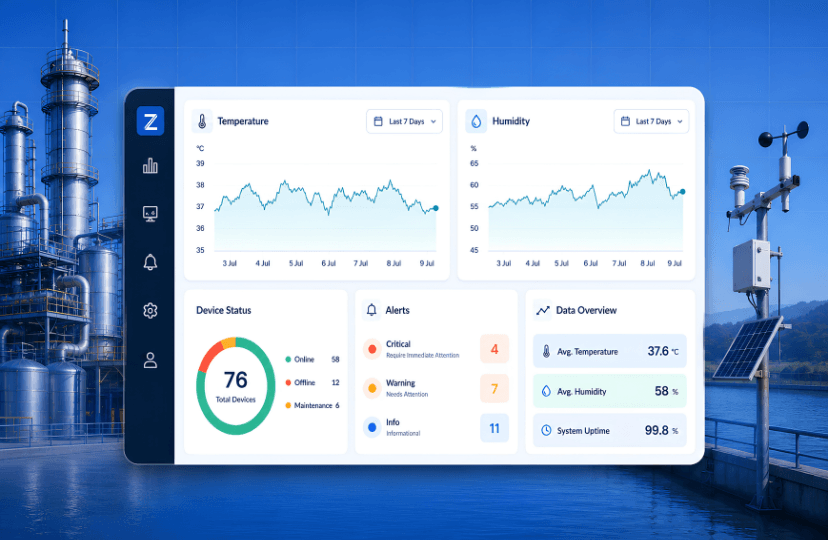
thingZmate® helps bring building water infrastructure into one centralized AIoT platform. Facility teams can monitor live water levels, pump status, borewell activity, connected devices, gateways, alerts, trends, and reports from a single dashboard.
Platform value for facility teams
- Live tank level widgets
- Pump status visibility
- Borewell monitoring
- Alert history and event logs
- Device and gateway health monitoring
- Usage trend visualization
Case Study Connection for Connected Water Infrastructure
Borewell monitoring is an important part of smart building water management because many facilities depend on borewells as a primary or backup water source. Without real-time borewell visibility, teams may not clearly understand source activity, water dependency, operating patterns, or maintenance requirements. IoT-enabled borewell monitoring improves source-level visibility, reduces manual checks, supports better water planning, and connects borewell data with facility dashboards. Related case study: Borewell Monitoring
Smarter Water Visibility for Reliable Building Operations
Water management is no longer only a plumbing or maintenance task. It is a critical part of smart building operations, resource efficiency, facility reliability, and sustainable infrastructure management. With real-time monitoring, facility teams can reduce wastage, prevent dry-run risks, protect equipment, and respond faster to operational issues. With Enthutech AIoT Solutions and the thingZmate® platform, buildings can move from manual water checks to connected, data-driven water management.
Table of Contents
- From Overflow to Pump Failure: Why Buildings Need Smart Water Monitoring
- The Operational Gap in Traditional Water Management
- Overflow and Dry Run Create Bigger Facility Risks
- Smart Monitoring for Tanks, Sumps, Pumps, and Borewells
- Water Monitoring as Part of Smart Building Management
- thingZmate® for Centralized Water Visibility
- Case Study Connection for Connected Water Infrastructure
- Smarter Water Visibility for Reliable Building Operations
Keep Exploring Our Blog Collection
© 2026, Enthu Technology Solutions India Pvt. Ltd. All Rights Reserved.