AIoT Architecture: How AI and IoT Work Together in Industrial Systems

Table of Contents
- Understanding AIoT Architecture in Modern Industrial Operations
- Industrial IoT vs AIoT: What Changes?
- Key Layers of an Industrial AIoT Architecture
- Edge AI vs Cloud AI in Industrial Operations
- From Industrial Sensor Data to Smarter Decisions
- Industrial AIoT Applications Across Sectors
- Industrial AIoT Challenges and Common Questions
- Build an AI-Ready IoT Foundation with thingZmate
Understanding AIoT Architecture in Modern Industrial Operations
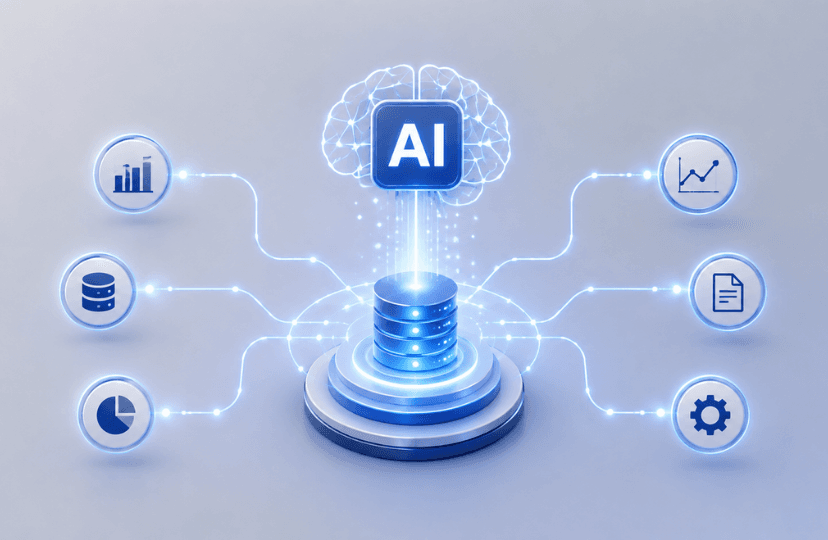
Artificial Intelligence of Things (AIoT) connects industrial sensors, IoT platforms, and AI models. Sensors capture what happens in machines, utilities, and environments. An IoT platform makes that data useful through dashboards, history, and timely alerts. AI models can then identify patterns and potential risks that fixed operating limits may not reveal. thingZmate® helps build the connected monitoring foundation before specialized AI services are introduced.
Industrial IoT vs AIoT: What Changes?
Industrial IoT connects assets, captures live readings, and applies rules for monitoring and response. AIoT extends that foundation with models that learn from historical behavior and support predictive insights.
- Sensors capture temperature, vibration, flow, and energy.
- Gateways connect equipment through suitable networks.
- IoT platforms organize assets, live data, and history.
- Rules and alerts flag predefined operating conditions.
- AI models can detect complex or emerging data patterns.
- Predictions support decisions, not automatic proof of faults.
- Operators remain responsible for critical actions.
Key Layers of an Industrial AIoT Architecture
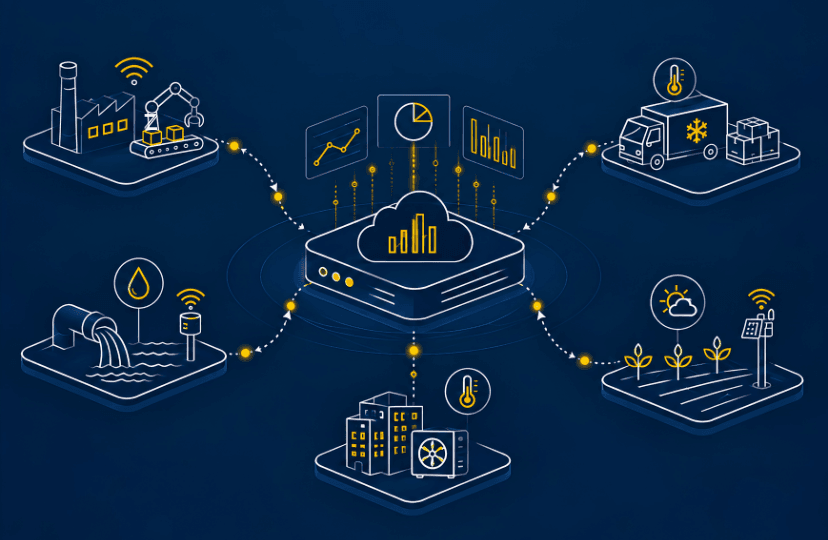
A practical AIoT system connects field equipment, networks, an IoT platform, and specialized AI services. Each layer has a clear job, helping organizations scale without creating isolated data systems.
Architecture from Field to Intelligent Action
- Device layer: sensors, meters, and PLCs collect signals.
- Gateway layer: field equipment and protocols connect.
- Network layer: Ethernet, cellular, or LoRaWAN carries data.
- IoT platform: thingZmate brings devices and alerts together.
- Data layer: historical records preserve operational context.
- AI layer: integrated models analyze patterns when required.
- Application layer: dashboards and workflows inform teams.
Edge AI vs Cloud AI in Industrial Operations
AI can process readings near equipment, in the cloud, or through a hybrid design. The choice depends on response time, connectivity, data volume, and costs. An IoT platform keeps monitoring useful in either case.
Where Should Intelligence Run?
Edge AI supports local checks where low latency matters. Cloud AI supports broader comparisons and model training. Hybrid designs combine these roles across multiple sites. Microsoft's IoT Edge guide illustrates local processing; thingZmate serves the operational monitoring layer.
From Industrial Sensor Data to Smarter Decisions
Example: Monitoring an Industrial Pump
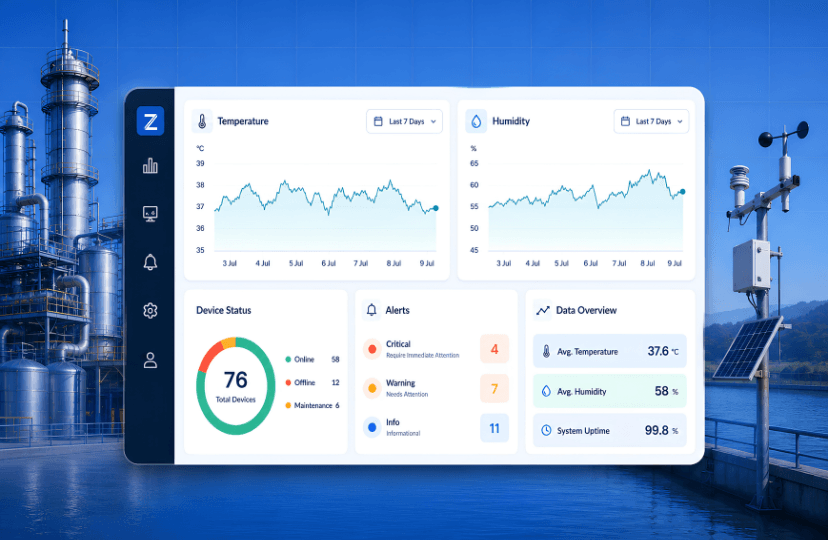
A pump reports flow, current, and temperature through connected sensors. With thingZmate, operators can see live readings, trends, and configured alerts in one place. Repeated changes in motor current can prompt inspection, while a separately integrated AI model could examine patterns to estimate developing maintenance risks.
From Measurements to Operational Response
- Capture readings with asset identity and timestamps.
- Check missing values, faulty sensors, and data gaps.
- Review live dashboards and historical operating trends.
- Use IoT automation for rules and suitable actions.
- Evaluate AI only on reliable, representative data.
- Treat predictions as evidence for human review.
- Record outcomes to improve future model validation.
Industrial AIoT Applications Across Sectors
- Smart water: monitor tanks and pumps; forecast demand with AI.
- Energy: track meters and explore changes in consumption.
- Machine health: use trends to plan condition-based checks.
- Cold chain: detect excursions and investigate recurring risks.
- Manufacturing: link equipment signals to process performance.
- Environmental monitoring: examine air-quality and weather trends.
- Smart campuses: connect water, energy, and facility assets.
Industrial AIoT Challenges and Common Questions
What Should Teams Check Before Deployment?
- Is AI essential? No; monitoring and rules solve many needs.
- Is the data reliable? Check timestamps, units, and gaps.
- Can older equipment connect? Often, through gateways.
- Edge or cloud? Choose based on latency and data needs.
- Do anomalies prove failures? No; verify operating context.
- Can AI control machinery? Only with validated safeguards.
- Is OT security covered? Follow NIST OT guidance.
- What measures success? Alert quality and operational impact.
Build an AI-Ready IoT Foundation with thingZmate
AIoT succeeds when teams first understand their connected assets. thingZmate® brings device monitoring, real-time dashboards, historical analytics, and alerts into one platform. It gives teams practical value today and a stronger foundation for future AI integrations.
A Practical Roadmap for Industrial Teams
- Connect priority devices and organize assets by location.
- Set up dashboards, thresholds, alerts, and reports.
- Review device health and the quality of historical data.
- Pilot external AI models only for a clear business need.
- Measure outcomes before extending the deployment.
Explore our AI-ready data guide and cloud monitoring guide. Planning AI-ready industrial operations? Explore thingZmate® to connect assets, monitor conditions, and prepare your data.
Table of Contents
- Understanding AIoT Architecture in Modern Industrial Operations
- Industrial IoT vs AIoT: What Changes?
- Key Layers of an Industrial AIoT Architecture
- Edge AI vs Cloud AI in Industrial Operations
- From Industrial Sensor Data to Smarter Decisions
- Industrial AIoT Applications Across Sectors
- Industrial AIoT Challenges and Common Questions
- Build an AI-Ready IoT Foundation with thingZmate
Keep Exploring Our Blog Collection
© 2026, Enthu Technology Solutions India Pvt. Ltd. All Rights Reserved.